Posts

Louisiana as it was in 1873

Image
Samuel H. Lockett (1837-1891) was an engineer and professor of engineering, who worked in an official capacity with the United States, and during the American Civil War, with the Confederate States. He conducted a topographic survey of the state of Louisiana from 1869 to 1872.  The Samuel H. Lockett manuscripts (LaRC Manuscripts Collection 826) consists of handwritten descriptive text and illustrations of two works by Samuel H. Lockett. Included in the collection are: Louisiana as it is (1873-1874); and The coast of Louisiana (undated). The second work is also included as a bound typescript. Throughout the first manuscript are small hand-drawn sketches of Louisiana scenes, and edited clipped proofs for possible publication; photographs are grouped together in a folder. A handwritten sheet listing an 1870 population table by parish and race, derived from the federal census, is an informative addition to the description of the state's natural topography and geogra...

pardon our progress

Image
New furniture is being constructed today by workers from DKI Office Furniture.   The reading room is closed until they finish the installation, possibly Tuesday afternoon. UPDATE, Wed. July 16, the reading room has returned to our normal hours as posted on the LaRC website.   It is always a good idea to check there for possible exceptions. Photo and post by Susanna Powers

Closed Tuesday morning, 7/15

The Schiro Reading Room will be closed  Tuesday morning, July 15, 2014,  for furniture installation.    

D-Day Love-Letter

Image
Today marks the 70th anniversary of D-Day, when Allied Troops landed on the beaches of Normandy in an invasion that ultimately turned the tide of the Second World War. The Louisiana Research Collection preserves the papers of Murrel H. Kaplan, who served  in the Army Medical Corps at the 64th General Hospital in Italy during World War II. In this letter to his wife, penned while listening to the radio broadcast of the battle, Kaplan recounts his and his fellow Medical Corps officers' experience of the event, as well as his eagerness for the war to end.                                                                                                                   ...

Discoveries in Jones Hall-- birthday parties on Constantinople Street

Image
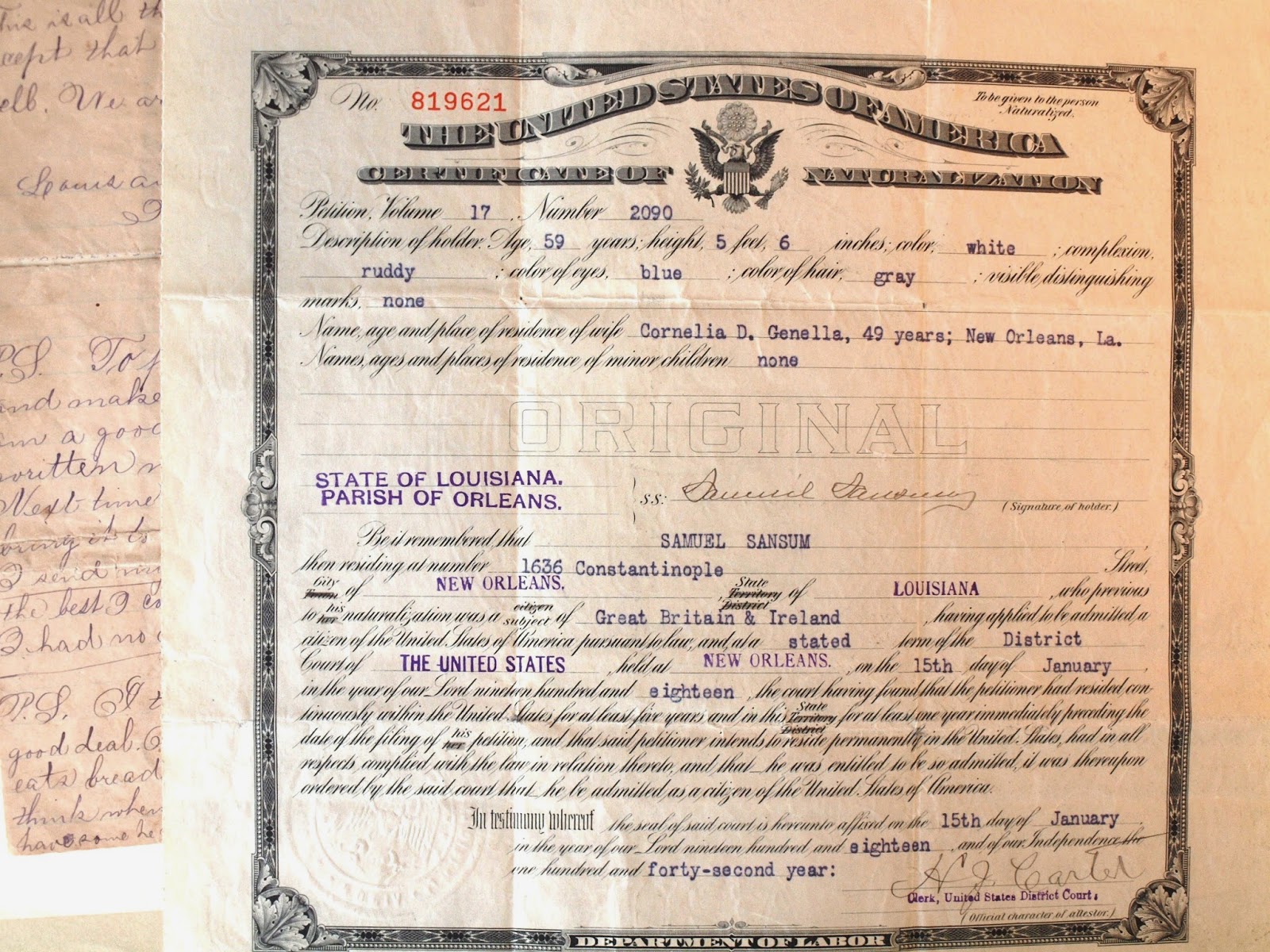
Cornelia Dean Genella Sansum (1868-1960) and her her husband, Samuel Sansum (1858-1945), a lawyer, lived at 1636 Constantinople Street in New Orleans during the twentieth century. Mrs. Sansum's mother was Mary Louise Kennedy (1836-1899). Cornelia and Samuel Sansum were married in 1902.  Mrs. Sansum donated her rather small amount of personal papers to the library in 1950, and they are held in the Louisiana Research Collection as Manuscripts Collection 586.   This collection consists of handwritten correspondence, affectionate birthday greetings from Sam to Cornelia, a business card, a calling card, advertisements, their marriage announcement, a reception invitation, Samuel Sansum's 1918 certificate of naturalization, and Cornelia Sansum's small prebound datebook into which she wrote birth, death, and marriage dates of some of her relatives. Names represented include members of the Sansum, Genella, and Kennedy families of Louisiana and Mississippi. In t...

Memorial Day

Image
Above is a translation and transcription of an unattributed wartime letter, written in French, presumably by a member of the American de Marigny family of New Orleans, during World War I.   These documents are in the de Marigny family papers, LaRC Manuscripts Collection 416, Box 1, Folder 4. The French original in the collection is itself a handwritten copy. Text of the letter's typed translation, from French into English: I am returning from the trenches/ where I suffered greatly/ I remained 48/ hours in muddy water/ up to my stomach, under a/ very violent firing from German cannons/ For a rest,/ we stay in the cellars/ of a ruined village,/ bombarded night and day./  Dead bodies everywhere a/ stench, it's a little like hell, nevertheless/ our troops an excellent morale,/ nothing seems to affect them.  This was/ is a massacre with/ all the refinements of/ cruelty that human intelligence/ has been able to discover./  The flooded lands where/ we ...

Civil Rights and the First Unitarian Church of New Orleans

Image
The Louisiana Research Collection has recently acquired the records of the First Unitarian Church of New Orleans. Among First Church’s records are the papers of Reverend Albert D’Orlando, who was a vocal Civil Rights activist in the 1960s. Reverend D’Orlando was especially active in the fight for the integration of New Orleans public schools. Below is a letter co-authored by Rev. D’Orlando and Charles Foster, the president of the church’s Board of Trustees, which describes the church’s the efforts  to support the families of children attending integrated schools, as well as teachers and protesters during this turbulent period in New Orleans’s history.  Transcription January 4, 1961 Dear Friends,                 Brotherhood itself is on trial today in New Orleans. At stake here is the future course of integration itself; for, it is clear that New Orleans will mark the turning point for ...