Posts

Showing posts with the label digitization projects

LaRC's Carnival collection in the news!

Image
LaRC is receiving much attention this week for our exquisite Carnival collection. This week, articles highlighting our Carnival holdings ran in both Tulane's New Wave and the Times-Picayune . Tulane University’s Louisiana Research Collection preserves possibly the largest collection of New Orleans Carnival paper and ephemera, such as invitations, dance cards, call out cards, printed float plates and bulletins, and original float and costume designs. Perhaps most notable among our Carnival collection are the more than five thousand original designs for Carnival floats and costumes we preserve. Many of these are from the “Golden Age” of Carnival and feature the work of noted designers such as Jennie Wilde, B. A. Wikstrom, and Charles Briton. LaRC also preserves the works of more contemporary designers, including Patricia Hardin, Olga Peters, and designer and noted Carnival historian Henri Schindler. We are in the process of putting our entire Carnival design collection online ...

LaRC's new digital collection, “Louisiana Political Ephemera, 1860-1920”

The Louisiana Research Collection (LaRC) preserves an extensive collection of political literature, such as handouts, campaign flyers, and political brochures. Such small printed items are called “ephemera” because they are meant to be glanced at and then tossed away; they therefore have a brief, or “ephemeral,” lifespan. This selection from LaRC’s political ephemera collection spans 1860 to 1920. In addition to being colorful and fun, campaign literature can be of enormous importance to a surprising variety of researchers. Campaign literature preserves a wealth of information, including a candidate’s name, race, sex, age, party, party faction, platform, resume, campaign slogan, business, offices held, endorsements, and a photograph of the candidate and or even the candidate’s family. It therefore is invaluable for a wide range of research topics and is often a useful place to start for many research projects. LaRC’s collection covers both local New Orleans elections, statewide Louisia...

Lippman collection of Civil War postal covers now online

Image
In 2009, the Louisiana Research Collection acquired a collection of Civil War period letters and postal covers from donor Al Lippman. The forty postal covers, with one exception , depict Union sentiment and patriotism. Many depict Confederate figures such as Jefferson Davis and General Beauregard. Sometimes these depictions are animal-like caricatures , others tend towards violent depictions, including several showing a hanging Jefferson Davis. Some postal covers portray a disdain of Britain's relationship with the Confederacy, others are steeped in Union patriotism and imagery of Uncle Sam. We have digitized the postal cover collection, and are pleased to announce its debut on the LOUIS Digital Library site. You can access the entire collection here . (Image from the Al Lippman Civil War Collection, Manuscripts Collection 993, Louisiana Research Collection, Tulane University Libraries. Image may not be reproduced without permission.) Posted by Eira Tansey.

Introducing the Twitter frog

Image
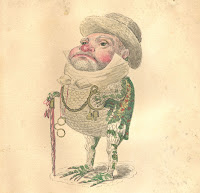
For those of you who follow our Twitter account, you may have wondered about this symbol we use. The frog is an image from the Mystick Krewe of Comus' 1873 "Missing Links" parade costume designs. The Missing Links parade was an important event in New Orleans' Mardi Gras history, becoming one of the first major instances of the use of satire and political commentary in a krewe parade. The "Missing Links" referred to the work of Charles Darwin, and the parade not only sent up the theory of evolution, but other topics of the day including Reconstruction. Tulane's Louisiana Research Collection has a complete set of the Missing Links costume designs. They are an important part of preserving the history of Carnival in New Orleans. We are currently making high quality digital copies of the designs, and plan to put together a digital collection of them later this year. (Image from Mystick Krewe of Comus' 1873 Missing Links Parade Costume Designs, Collection...

Selected Manuscripts Finding Aids now online

We are excited to announce that a selected group of our Manuscripts finding aids are now online. The finding aids are currently in a PDF format, and users will need a PDF reader to download and use them. Patrons can also search for keywords in most of the finding aids. This is just a small sample of the more than 1,000 manuscripts collections we hold, and we are planning to add more. If you wish to see a finding aid that isn't on the page, please contact us , and we will be happy to make it available if resources allow. Many of our noted collections now have their finding aids available online for the first time, including the papers of John Kennedy Toole , Rudolph Matas , Charles Colcock Jones , and Natalie Scott . We also have organizational records from the Christian Women's Exchange , First German Lutheran Church , Council of Social Agencies , and the Orleans Parish Medical Society . Many thanks to Neal Schexnider for his assistance with getting these online. Posted by Ei...

Our day at the Lakefront

Image
Six of us in Special Collections attended a SOLINET-sponsored class on Feb. 5 at the University of New Orleans Library. The topic was Digital Imaging of Library and Archival Materials, and it included individual hands-on work in Photoshop and OmniPage Pro, as well as wide-ranging discussions about planning for digital preservation and access projects. While the workshop was technical in nature, the fundamental theme of the day was the necessity of providing strong, well-informed, collegial decision making prior to undertaking new digitization projects for special library materials. Putting procedures into place requires an analysis of the best options for software, file quality and size, storage medium, backup location for disaster planning, file naming conventions, and realistic budgeting for the equipment and ongoing staffing needs for the proposed projects. Some aspects of this developing field do not have firm industry and professional standards, but rather a choice between what ar...